In 1944, on the eve of the Allied invasion of Normandy, the British Army was desperately short of junior officers, whereas Canada had a temporary surplus of such officers. In the hope of solving both problems at the same time, the military authorities of the two countries agreed that a substantial number of junior Canadian infantry officers would be lent, on a voluntary basis, to Britain.
The appeal for volunteers was answered by several hundred Canadian officers who were eager to get into action and who seized the opportunity to go overseas. Though not an elite group in the usual sense of the word, they were nevertheless chosen to reflect credit on Canada and the Canadian Army.
From: Codeword CANLOAN
by CDN198 Wilfred I. Smith
A total of 673 Canadian men volunteered for service as officers with the British Army. Of these, 50 were selected as ordnance officers, while the rest were assigned to serve in British active regiments.
Before heading overseas, the volunteers were sent to the A-34 Special Officer’s Training Centre in Sussex, New Brunswick, where they underwent an intensive but brief training program under the command of Brigadier Milton F. Gregg, VC, MC. The training aimed to prepare them physically and tactically for active duty, while also familiarizing them with British military culture and customs.
After completing their training, the officers were shipped to the United Kingdom in groups of 50 to 150. Upon arrival, they were posted directly to British regiments—where possible, to the British unit affiliated with their Canadian regiment. Some officers requested specific assignments based on family connections or personal ties to a particular regiment; such requests were usually granted.
These officers, known as CANLOANs, were given special service numbers beginning with “CDN” to distinguish them from their British counterparts.
Service and Combat
CANLOAN officers saw some of the most intense combat in North-West Europe between 1944 and 1945. Many took part in the Normandy landings and the subsequent campaign through France, with some continuing to fight through to the final battles in Germany. Although the original plan focused on North-West Europe, CANLOANs also served in Italy, and a few even volunteered for deployment to South-East Asia.
Officers who were wounded but later recovered often rejoined the fight, sometimes being assigned to entirely new units. As a result, many served in two or more regiments during their time overseas. In British units, they received typical wartime promotions—some rose to the rank of Company Commander, and one even served as the Commanding Officer of a battalion.
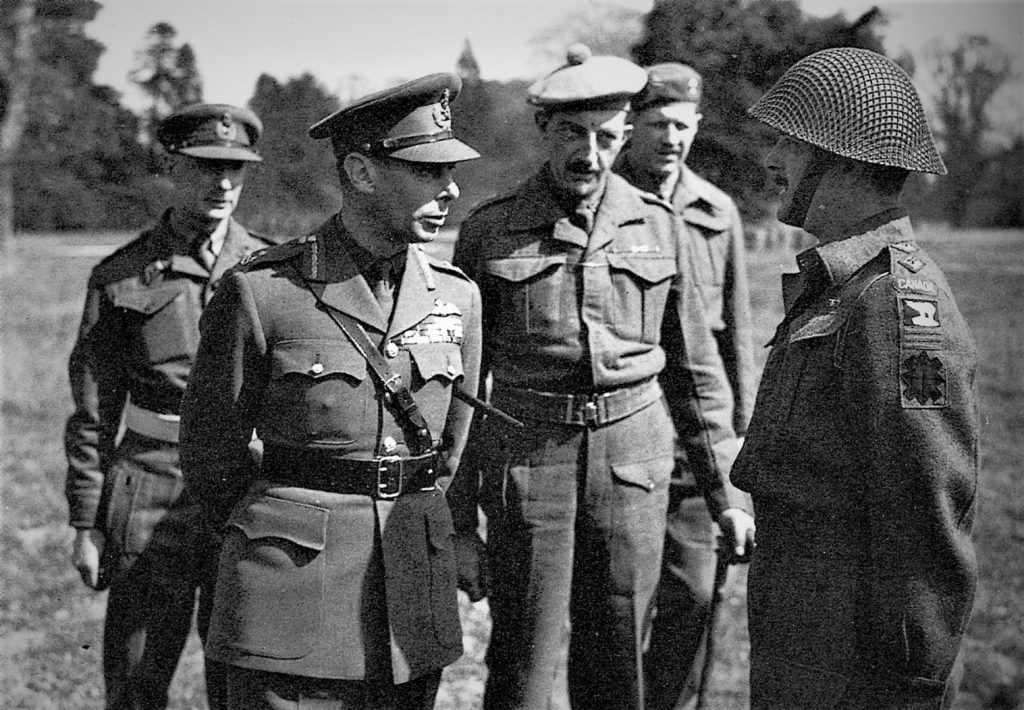
While serving with British regiments, they wore standard British unit and formation insignia, along with the “Canada” shoulder flash.
Sacrifice and Recognition
Of the original 673 CANLOAN officers:
- 128 were killed in action or died of wounds,
- 310 were wounded, and
- 27 became prisoners of war.
Their bravery and professionalism earned them numerous decorations, including:
- 41 Military Crosses (including 1 with Bar),
- 1 Silver Star (U.S.),
- 1 Distinguished Service Cross (UK),
- 4 French Croix de Guerre,
- 1 M.B.E., and
- 1 Dutch Order of the Bronze Lion.
Additionally, many were mentioned in dispatches or received Commander-in-Chief’s Commendations. Some had already been decorated before CANLOAN service, bringing with them 2 Distinguished Conduct Medals and 6 Military Medals earned in the Canadian Army.
Legacy
After the war, surviving officers formed the CANLOAN Army Officers Association, which hosted reunions and published a quarterly newsletter, The CANLOAN Review. Though active for many years, the association has since disbanded, as all CANLOAN officers have now passed on.
In 1961, a memorial was erected on the banks of the Rideau River in Ottawa to honour the fallen. It bears the names and CDN service numbers of the 128 CANLOAN officers who died in service, a lasting tribute to their courage and sacrifice.